Posted on

How to incorporate GLBC’s SayLa Bee Infused Honey in your Thanksgiving turkey dinner

Thanksgiving turkey - Great Lakes Bee Company SayLa Bee Infused Honey

Thanksgiving is right around the corner! We’re looking back at our classic honey glazed turkey recipe, and experimenting with a sweet new favorite: roasted apples and sweet potatoes with a honey bourbon glaze. For extra splashes of flavor in the rest of your holiday cooking, take a look at our SayLa Bee Infused Honey!

Honey Glazed Turkey:
• Turkey
• 1/2 cup honey
• 1/2 cup Dijon mustard
• 1 teaspoon dried rosemary
• 1 teaspoon onion powder
• 1/2 teaspoon salt
• 1/2 teaspoon pepper
• 1/2 teaspoon garlic powder

Tie the turkey’s drumsticks together and tuck the wings underneath. Place turkey in roasting pan breast side up and bake at 325° F for two hours. Mix honey, Dijon mustard, dried rosemary, onion powder, salt, pepper and garlic powder in a bowl and brush over turkey after first two hours of baking. Want some extra flavor? Our SayLa Bee Pepper infused honey adds an extra kick!

Return the turkey to the oven and continue to baste with pan drippings until thermometer reads 180° F (about two hours). Remove the turkey and cover it with tin foil for up to 15 minutes before carving. Serve with stuffing and gravy.

Roasted Apples and Sweet Potatoes with Honey-Bourbon Glaze:
• 5 large sweet potatoes
• 3 Golden Delicious apples
• 1/4 cup fresh lemon juice
• 2/3 cup firmly-packed brown sugar
• 1/2 cup honey
• 6 tablespoons unsalted butter
• 1/4 cup bourbon
• 1 teaspoon ground cinnamon
• 1/2 teaspoon ground ginger
• 1/2 teaspoon salt
• 2/3 cup coarsely chopped pecans

Wash sweet potatoes, and place on a baking sheet; prick with a fork. Bake at 400° for one hour or until almost tender. Remove from the oven, and let it stand or 45 minutes or until cooled.

Meanwhile, peel and core apples. Slice apples into 1/3″ thick wedges; toss with lemon juice in a bowl. Peel cooled potatoes, and slice 1/3″ thick. Arrange potatoes and apples alternately in a greased 13″ x 9″ baking dish. Pour remaining lemon juice over potatoes and apples.

Combine brown sugar, honey, butter, ginger, salt, cinnamon, and bourbon in a saucepan, stirring well. For extra flavor, try SayLa Bee Honey in cinnamon or bourbon flavors!

Bring to a boil over medium heat, stirring occasionally; boil two minutes or until slightly thickened. Pour glaze over potatoes and apples. Bake, uncovered, at 400° for 30 minutes. Remove from oven; baste with glaze in bottom of dish, and sprinkle nuts across top. Bake 14 to 15 more minutes or until apples look roasted. Baste with glaze just before serving.

Enjoy!

Great Lakes Bee Company SayLa Bee Infused Honey - Bourbon
Great Lakes Bee Company SayLa Bee Infused Honey - Black Pepper
Posted on

Great Lakes Bee Company Launches New Michigan-Made Honey In Celebration Of Honey Harvest Month


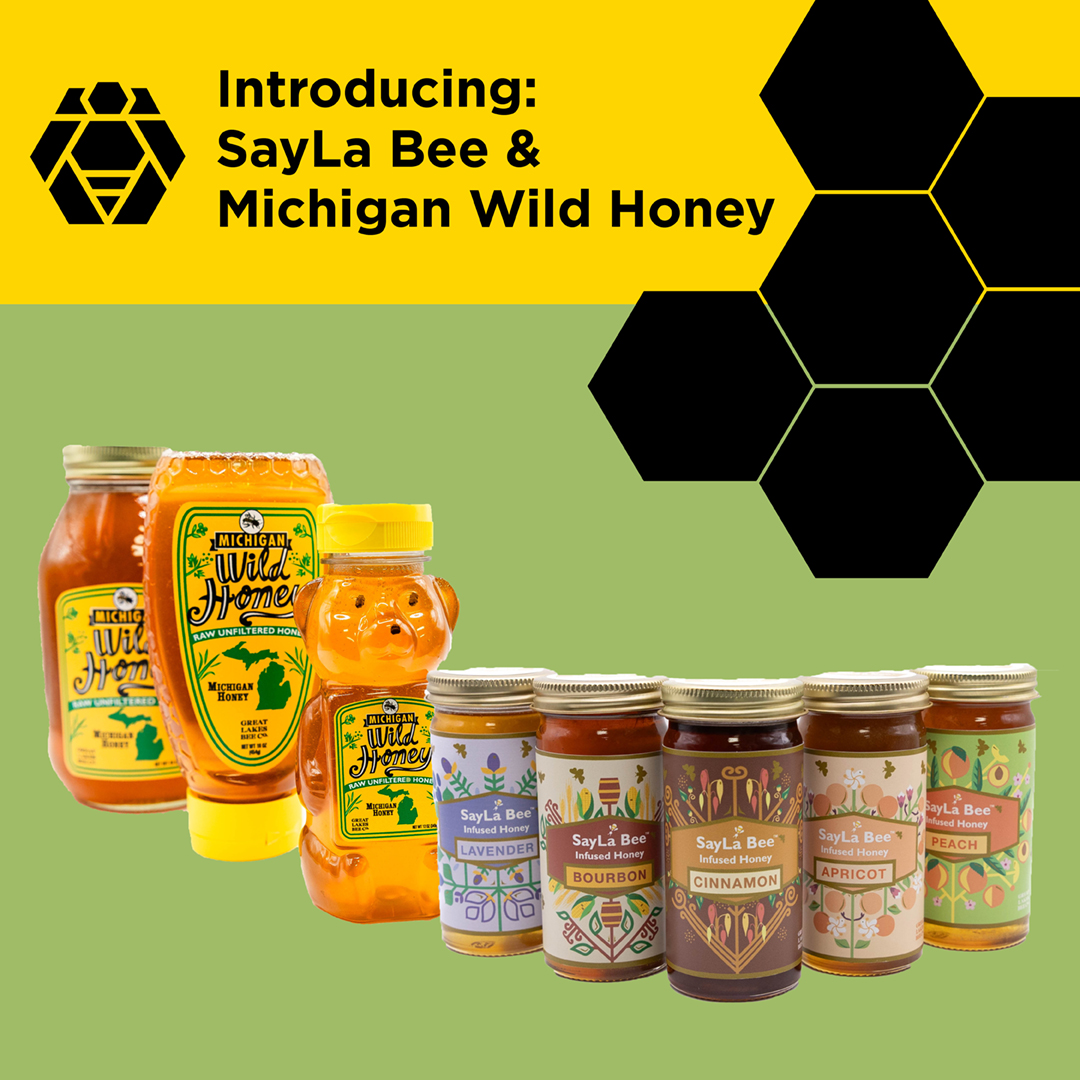
Continuing our celebration of National Honey Month this September, let’s properly introduce our two latest Michigan-made honey collections, SayLa Bee Infused honey, and our new brand of raw, unfiltered Michigan Wild Honey – both hand bottled right at the Great Lakes Bee Company facility in Fremont!

Our SayLa Bee Infused honey is pure, unfiltered, raw Michigan honey that is infused with a variety of flavors, ranging from sweet, fruity flavors like blueberry and apricot, to richer flavors like chocolate and cinnamon. There are a total of 18 SayLa Bee Infused honey flavors, and each come in the 6oz and 12oz options.

Our SayLa Bee products not only taste delightful, but nourish the body and soul – rose calms and relaxes, while orange supports immunity, and chocolate is a mood booster. Every ingredient that we use adds something special to our food and health!

Our Michigan Wild Honey is raw and unfiltered from hives across Michigan. The honey is carefully extracted, strained and filled without overheating. The summer harvest of Michigan Wild Honey captures the diverse flavors of area wildflowers, flowering trees, clover, lavender and thistle all blended into a lovely natural mix of medium-amber Michigan deliciousness.

You can shop the SayLa Bee collection and Michigan Wild on our website.


Posted on

May in the Hive

Great Lakes Bee Company - May in the Hive graphic


Welcome back to bee season! Your bees should be settling into their hives, and they may even be in a good mood if they have access to plenty of flowers and greenery. For tips on gardening catered to your bees, check out our recent gardening blog! Bees can be easier to work with in environments they like!

There’s no need to frequent hive check-ups this month. You can still monitor your bees, but excessive interference can disrupt their natural activities and reduce productivity. Checking on the hive sparingly will help maintain the bees’ productivity and won’t interrupt their natural rhythm.

We loved seeing all of your faces for Bee Nuc Pickup Day earlier this month! Photos from the event are below. We also posted additional photos on our Instagram and Facebook channels, where you can always hear the latest buzz about upcoming events, promotions, and news.

Posted on

April in the Hive


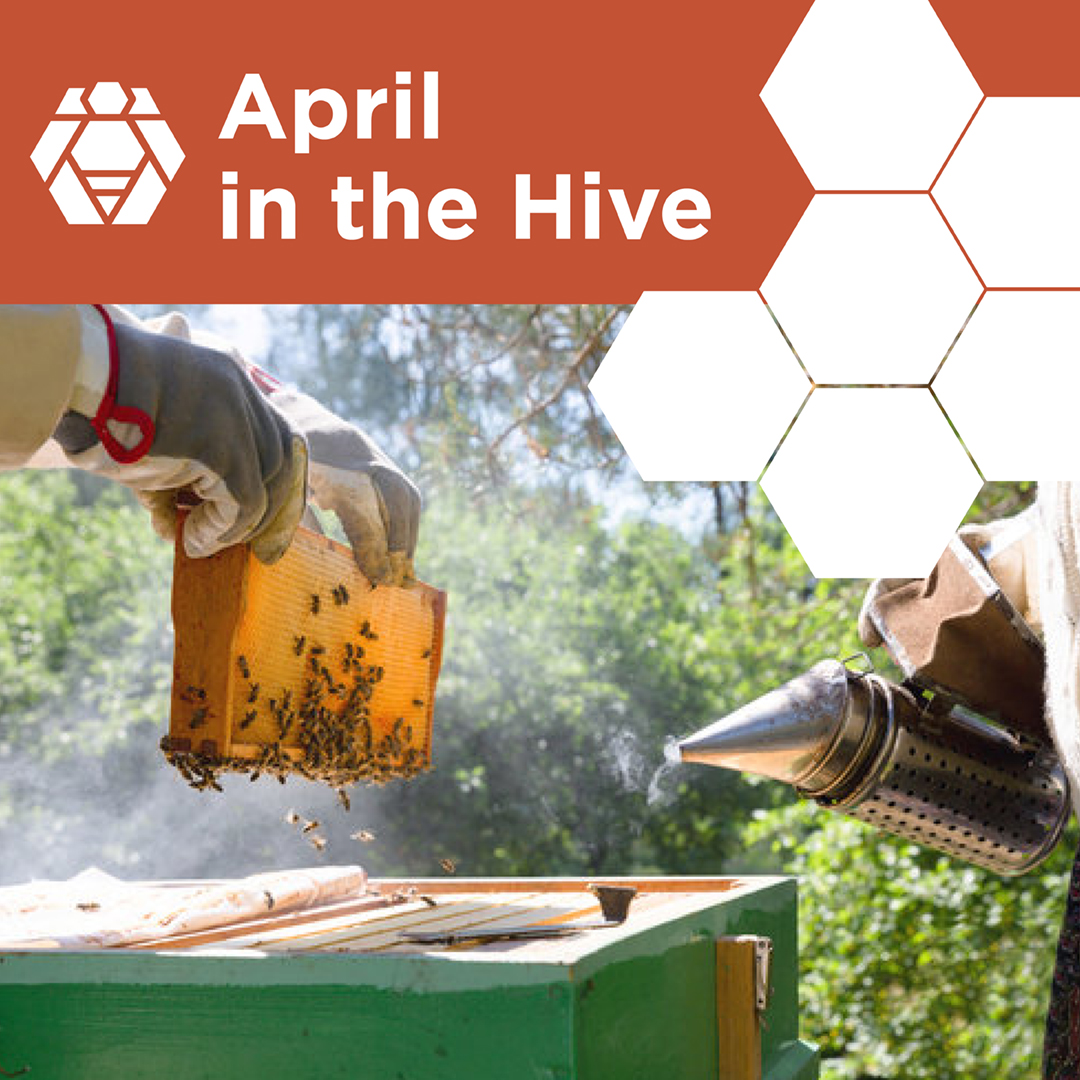
Good friend of the Great Lakes Bee Company Larry Hasselman once told us “the hardest part of beekeeping is lighting the smoker!” Beekeeping novices and veterans alike may find themselves needing to refamiliarize themselves with their beekeeping equipment as spring rolls around.

Let’s walk through the basic and most essential equipment to help you get started!

Hive Tool

  • Hive tools are an essential and versatile piece in your beekeeping toolkit. When bees glue everything in the hive together, the hive tool allows you to detach the combs from the sides of the hive, cut and scrape propolis, and even remove nails or take apart boxes.

Smokers and fuel

  • Bees are naturally aggressive creatures, which is why beekeepers use smokers to make their bees docile. Smokers mask the pheromones let out by guard bees, which minimizes the defensive reaction from the colony, allowing for effective and safe hive inspections.

Queen clip

  • Queen clips are used to pick up or hold a queen bee. The clip acts as a cage that contains the queen, but the bars still permit worker bees to pass through and attend to the queen’s needs. The clip helps protect the queen during any work that needs to be done inside the hive.

Feeders

  • Feeders are convenient for feeding bees and checking on your sugar syrup levels without needing to open your beehive. Typical entrance feeders have a jar filled with syrup that drips onto a tray, which is inserted to the front of the hive.

Protective gear

  • The most important equipment in your arsenal will be your protective gear. Veils and gloves protect your head and face from any arrant aggressive bees, and prevent stings.

All of this equipment and more is available in our online store!

AND … If you’re looking to purchase bees, we still have 5 Frame Nucs and Mated Queens available for purchase online!

Our 2025 Spring Bee Pick-Ups dates are:

  • Packages & Queens: Tentatively scheduled for Saturday, April 19
  • Nucs: Confirmed for Saturday, May 10
  • Location: Great Lakes Bee Company, 5973 S. Warner Avenue, Fremont, MI 49412
  • More info: https://bit.ly/2025_GLBC_BeePickups
Posted on

March in the Hive


It’s time to think spring! March is all about getting your apiary ready. Depending on the climate in your area, you can perform regular checks on the hives. On the warmest days, you can clean out your hives and inspect the status of the bees; check out January and February in the hive for last minute tips. There is still a chance that your bees are alive, but may not make it much longer if the temperatures continue to fluctuate. Don’t be discouraged if your bees didn’t overwinter! Michigan winters can be unpredictable. Instead, look forward to the new season, and decide what you’d like to change or do differently.

This is a great time to restock your supplies, or look into upgraded equipment. Before your supplies run out, order early to ensure you get them in time. You can also check out our options for bee packages. They will be available at GLBC in early to mid-April, with nucs coming early in May. If you’re wondering what kind of bees to get this year, check out our “No Bad Bees” blog, where we discuss the options available in our store and their pros and cons.

Posted on

No Bad Bees


Even though the blustery winter weather is upon us, it’s not too early to think spring. And with spring, comes bees!  If you’re thinking about purchasing a new batch of bees, Great Lakes Bee Company offers different types of honey bees to choose from, each with their own unique benefits. Let’s go through the types of bees we offer, and you can decide which is right for you!

Italian Honeybee

  • These are some of the most widely used race of honey bees. They are known for their prolific brood cycles and production, gentle nature, and their reluctance to swarm. They are also excellent foragers and are known for being strong comb builders. However, this Italian breed consume resources at a rapid pace due to their long brood cycles, and they are notorious for robbing the reserves of weaker or neighboring hives. Italian honey bees also tend to have more difficulty with pests and are more prone to collapse because of this. Despite that, the Italian honeybee is still used by both novice and experienced beekeepers alike.

Carniolan Bee

  • Another popular bee among novices, the Carniolan bee is favored for their docile nature. Carniolan bees are also renowned for their long tongues, which help them pollinate crops like clover, meaning they have more sources of nutrition for the colony than the traditional strain of honey bee stock, and because of their origin in central and Eastern Europe, Carniolan bees are best at foraging in colder climates. Carniolan honeybees are also some of the most efficient workers, due to their ability to adjust worker population relative to nectar availability, creating periods of high nectar with high worker population. This creates large quantities of honey and pollen during those periods.

Saskatraz Honeybee

  • Saskatraz bees are a newer addition to the beekeeping world, a recently developed breed where scientists aimed to create a honeybee breed with strong resistance to pests and diseases. More recently, Saskatraz honeybees have undergone more selective breeding processes to try and increase stability of the varroa tolerant trait. Due to their highly selective breeding process, Saskatraz bees are harder to acquire than other breeds of honeybee. The specificity of their foraging behaviors may affect their honey production in certain environments, meaning supplemental feeding may be necessary. You can read more about this new breed on OHBees!

Golden West Honeybee

  • The Golden West Bees originated in the California foothills, where a family of beekeepers began to selectively breed their bees when they noticed one of their hives were able to completely avoid mite infestation. From this breeding, Golden West queens have become notable for colonies that are very gentle and healthy, exhibited above average honey production, and proved strong for almond pollination, on top of their increased mite resistance.

Now that you know a little more about the different honeybees we offer, head on over to our online shop to explore your options for the upcoming season! Keep in mind that there are no bad bees, and a flexible beekeeper who has careful consideration of their hives will often have the best results!

Posted on

November in the Hive


You should already be preparing your hives for colder weather by providing plenty of food for your bees and insulating the hive, but November means your bees may be entering dormancy.

A strong hive won’t need much help feeding during the winter. To know how much assistance your bees may need to keep their nutrition up, look at their stores of honey. If the honey has been recently depleted or the bees have simply not produced enough, it may be time to add sugar, fondant, or liquid feed to the mix before it gets too cold.

You can also prepare for the cold by providing wind-breaks, such as hay bales or scrap metal, to protect your hives from harsh wind. But be careful not to shade the hive, as the bees will be needing as much warmth and sunlight as they can get.

Now is the time to start preparing for next year! Take stock of what kind of equipment you’ll need, such as more hives, new foundations, or more specialized tools. We have a variety of bee equipment and hive tools available for purchase online at Great Lakes Bee Co.! You can also spend the extra time this winter not tending to your bees by studying up on bees and beekeeping. Check out this selection of books recommended by the Best Bees Company!

Posted on

Why The Metropolitan calls Great Lakes Bee Co. honey ‘delicious’ honey and beeswax candles a ‘rich experience’


The Metropolitan, a publication based in Detroit, featured Great Lakes Bee Company’s Hasselman’s Honey and beeswax candles in its June 2024 article, “What do you get by mixing, honey, hot sauce and fried chicken?”

Here’s why The Metropolitan’s staff called our honey “delicious” and the aroma and glow of our beeswax candles a “rich experience.”

The Metropolitan: What do you get by mixing, honey, hot sauce and fried chicken?

Hasselman’s Honey (and, beeswax candles) | Fremont, MI

Since 1974. 100% Local Western Michigan, Unprocessed, Raw & Unfiltered.

Last month, we sent contributing crack storyteller, Jamiel Dado to the west side of Michigan to see what he could dig up on the bee community and those products associated with what the Empire called, Apis mellifera. In his article, “Beeing There,” for The Metropolitan, Jamiel wrote about his journey to Kropscott Farm Environmental Center and observations and discussions from our bee class.

While his experience can be found in the previous link, we’d like to discuss a couple of the products coming out of Great Lakes Bee Company.

It says right on the bottle that Hasselman’s Honey comes straight from the hive, with all the benefits natural honey has to offer. While there is rigorous debate over the health benefits associated with honey – natural sugar vs processed, local honey vs global, etc. – those who keep bees are confident that locally produced, raw, unprocessed honey not only tastes great but provides a myriad of benefits to better living (myriad, a word I do not use in daily conversation but thought it worked given the previous Latin).

We spoon this robust honey on our homemade bread and toast, in our bowl of Whole Milk Greek Yogurt w/ berries, and stir it in our afternoon teas.

Delicious!

Had I been with Jamiel, I might have asked Hasselman what makes the flavor of their honey unique? What flowers contribute to its taste? Does Lake Michigan have anything to do with the end product? How do we safely and ethically support bee communities into producing their finest product? And, how should bees be compensated for their work?

But, alas, I was not there.

Apart from Hasselman’s Honey, we have also been writing by beeswax candlelight for the past 30 days and must say, it has produced a much richer experience – we enjoy the aroma and its soft, flickering, glow!

Hasselman’s small batch honey comes from the Western Shores of Michigan and is hand bottled in Fremont, Michigan, by the Great Lakes Bee Company.


Posted on

Benefits of dark chocolate and rose


Did you know our infused honey not only tastes good, but has certain health benefits too? Let’s have a closer look at our Rose and Dutch Chocolate infused honeys.

Yes, our Rose-infused honey makes a Brie cheese spread spectacular and is a savory addition to tea, yogurt, ice cream and your morning pancakes. BUT rose is also known for its antibacterial, anti-inflammatory, and antimicrobial properties, which can increase dopamine and help with anxiety and depression. Rose is also helpful in sickness and cancer prevention, especially breast or cervical cancer, and helps reduce inflammation, pain, and menstrual cramping. Think about that extra punch of antioxidants, vitamin C and vitamin E the next time you pour rose honey in your afternoon tea.

Now, our Dutch Chocolate-infused honey – that is something that satisfies our sweet tooth AND our body’s natural “feel good” chemical, serotonin. Have you ever taken a bite of dark chocolate and felt instant happiness? That instant joy and satisfaction comes from an increase in serotonin due to the chemical make-up of tryptophan (amino acid that helps make serotonin), phenylethylalanine (natural anti-depressant), and theobromine (mood relaxer and stress reliever) – all of which are found in dark chocolate.

Additionally, the flavanols in dark chocolate are also known to help with cardiovascular disease and improve metabolic health, which can lead to lowering blood pressure and LDL cholesterol (bad cholesterol) and alleviating diabetes. Dark chocolate is also high in antioxidants, which can enhance insulin secretion, improve insulin sensitivity, prevent inflammation, and create a fat-lowering effect. It is also rich in nutrients, including fiber, iron, magnesium, copper, potassium, phosphorus, zinc and selenium. Go ahead and pour our Dutch Chocolate infused honey on, well, anything, and get a dose of sweetness while also packing in some nutrients.

Don’t have our Rose or Dutch Chocolate honeys? Check out our varying sizes of infused honey here.

Note: These statements have not been evaluated by the FDA. This product is not intended to diagnose, treat, cure, or prevent any disease.

Posted on

Looking for a last-minute holiday gift? Why bees and beekeeping classes make great gifts for the holidays or any occasion


Great Lakes Bee Company Owner Genji Leclair and General Manager Stefan Braun talked with FOX 17 Morning Mix and WOOD TV8 about how bees can make the perfect last-minute holiday gift.

“Bees are fascinating,” Leclair told FOX 17. “They’re important and have such a contribution to farming, agriculture, our food supply and they’re fun to take care of.”

Braun, who admits to being fascinated by any “creepy crawlies,” told FOX 17: “Bees carry a special place for me. I’ve been around them since I was a little kid. Once I became an adult, I dove in head first and learned everything there is to know about bees and want to continue learning about them.”

Leclair shared that if you’re thinking about giving the gift of bees for any occasion, there are some things to take into consideration, Leclair and Braun said.

“To take care of a domesticated animal – that is the honey bee – that’s something that can’t be taken lightly,” said Braun. “It is a chore and it is a job – and I love doing it.”

“When giving bees as a gift you want to make sure the person you’re giving it to – it’s like giving a puppy or any kind of animal – that they’re up for the challenge and the long-term commitment,” said Leclair. “A lot people think bees, because they’re wild insects, you can put them in their hive and they’ll be okay. But that’s not the case. In choosing a gift like this for someone, you want to make sure that this is something that they’re up for and would be committed to.

“You also want to make sure that they’re not allergic to bees,” Leclair added. “Bees do sting and some people are allergic, so you want to take that into consideration as well. Other than that, there’s some ongoing costs. Just like taking a dog to the vet and getting those vaccines, there’s care for the hive as well because there are different things that can happen in the hive – you might have to replace your queen, you have to treat the hive for certain things. Other than that, it’s fascinating and it’s so fun and amazing to be in the bee world.”

Great Lakes Bee Co. also wants to help beekeepers – new and experienced – with their bees. They’re offering beekeeping classes on March 9 and March 23. Classes are from 9 a.m. to 1 p.m. and are $50. Online registration is open.

“It’s a beginner bee class that will tell people how to prepare their location for the bees, how to maintain their bees, what kind of elements to look for in their bees and, of course, the most important part, how to harvest their honey; and how to make it a relationship between the beekeeper and the hive,” said Braun.

“A lot of times when people want to start beekeeping, they don’t know exactly what they need to have to start beekeeping, so we thought it would be a good option to allow people to purchase their bees, their hives and all the accessories they’ll need to go with it,” Braun told WOOD TV8. “It’s really handy for newbie beekeepers to know what they need to start out.”

“When I moved to Michigan and started to get into bees, I had no idea where to start,” Leclair said during her interview with WOOD TV8. “I just knew I loved honey and wanted to do something great for the environment. A lot of people just don’t know a lot about the importance of bees, what they do for the environment, how they impact the local ecology around their areas, the agriculture and their own garden. Beekeeping is one way you can really support your local farmer or even your own local grower, and also get some honey.

“Having access to information and someone who can mentor and demonstrate what it’s like to interact with the bees, how to set up a bee hive, how to protect yourself when you’re working with bees and some of the ins and outs of beekeeping is a great way to start your adventure in beekeeping, and have a little confidence in going into getting your bees started,” she added.

What’s Leclair’s favorite part about bees: Honey

“We have local, raw, unfiltered, unprocessed honey – it’s so healthy for you and it tastes so good,” she said. “Anytime you can get local, raw unprocessed honey do it from your local beekeepers. In addition to that, the hive has a lot of great byproducts like beeswax, and honeycomb and infused honey.”

Honey bees, honey and bee products and swag are available on the Great Lakes Bee Co. website. Beekeeping equipment will be available for purchase on the website in January 2024.

Watch both segments here: